


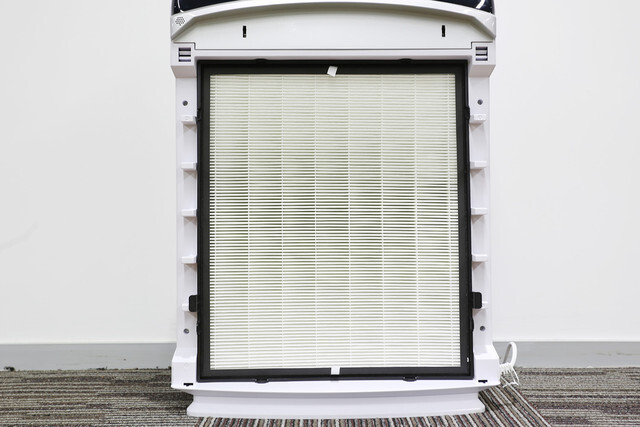
Can an air purifier achieve its nominal purification effect after the filter replacement?
The Hebei Provincial Environmental Protection Institute's survey involved seven models from six popular air purifier brands in the market. In addition to the filters that were included randomly, replacement filters from the manufacturers were acquired along with third-party compatible filters from three leading brands ranked in sales on well-known domestic e-commerce platforms, totaling 34 batches of products.
According to Xiao Jun from the Environmental Protection Product Inspection Department of the Hebei Provincial Environmental Protection Institute, this investigation was conducted based on national standards for air purifiers. It involved testing and analyzing the amount of clean air produced by the air purifier for particulate matter and formaldehyde (which was claimed to be addressed). These two indicators directly reflect the purification capacity of the air purifier per unit time for particulate matter or formaldehyde and are the main indicators of its performance.
Test data shows that the manufacturer's official filter products meet the stated requirements of the air purifier for both indicators. The clean air output for particulate matter from third-party compatible filters meets standard requirements, but the formaldehyde purification performance is relatively poor. Among 20 batches of products that were claimed to have formaldehyde purification capability, 17 batches failed to meet the nominal requirements of air purifiers, resulting in a non-compliance rate as high as 85%. One batch of products yielded a formaldehyde clean air output of 3.7m3/h, achieving only 2.5% of the claimed value of 150m3/h, which indicates that it essentially lacks a formaldehyde purification function.
Xiao Jun noted that during the testing process, differences were found in the thickness and quality of third-party compatible filters compared to the original products. The varying levels of filtration resistance led to differences in air flow rates during use compared to the original filters, resulting in significant instability in formaldehyde purification performance.
It is reported that the price differences in filters mainly depend on raw materials and production processes. Lower-priced filters mainly use layered structures and simpler manufacturing processes, while composite filters have more complex production processes and better purification effects, resulting in higher prices. However, a higher price does not necessarily equate to better performance; what is essential is compatibility with the purifier. While original filters are good, their price is relatively high. If we consider 500 Yuan as a dividing line for high and low grades, currently, the sales volume in the market is approximately divided equally, and there is no significant difference in sales volume among different grades of products.
The Hebei Provincial Environmental Protection Institute recommends that consumers refer to the test data and, in combination with their own living environment and different usage purposes, choose filters reasonably, considering factors such as price and purification effect, to avoid paying for features that do not meet their needs or for effects that do not meet expectations.